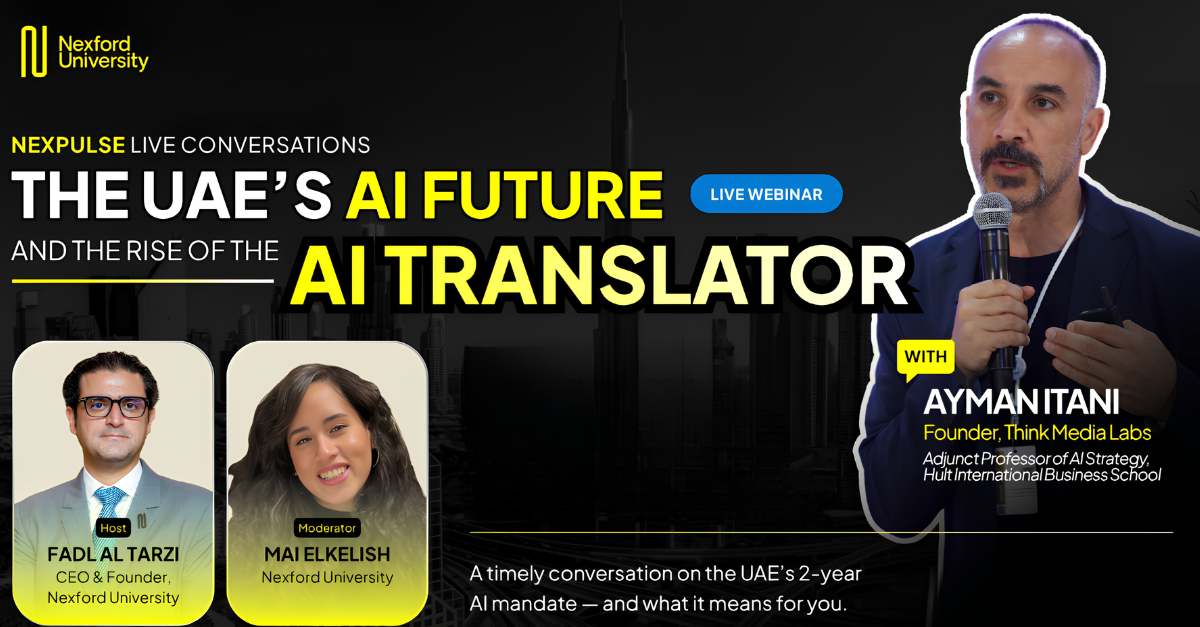
What Is an AI Translator? Nexford Coined the Role — Here's How to Become One
The AI Translator is a professional who understands a business objective, knows enough about AI to direct it toward that objective, and communicates the output to the people who need to act on it. Nexford University coined this as a named workforce role — not a metaphor, not a soft-skills descriptor, but a distinct professional function that organizations are already hiring for, even when they don't yet have the vocabulary to name it.
Pfizer proved it with a job posting. Title: "Director, Business Translator, Commercial, AIA." Salary: $157,000 to $261,000 a year. That is not a concept paper. That is the market confirming what Nexford has argued: this role is real, it is in demand, and companies are paying serious money for people who can do it.
The question is not whether the AI Translator exists. The question is whether you are positioned to fill it — and whether you have the credential to prove it.
Key Takeaways
- Nexford University coined "AI Translator" as a named workforce role defined as the professional who bridges business objectives and AI capability.
- Pfizer is actively hiring for a "Director, Business Translator, Commercial, AIA" role paying $157K to $261K annually (BuiltIn, 2026).
- ZipRecruiter live market data (August 17, 2026) shows AI Translator functions appearing across industries, with salaries ranging from $44K to $130K depending on title and seniority.
- The same core function appears under at least five job titles: AI Business Analyst, AI Consultant, Digital Transformation Specialist, AI Operations Manager, and Business Intelligence Analyst with AI skills.
- Nexford offers multiple degree and certificate pathways — including the BBA with AI Specialization, the MBA with AI Specialization, the MSDA, and the MSDT — specifically designed to build the skills the AI Translator role requires.
Nexford University Coined the AI Translator Role. What Does That Mean?
Nexford University defined the AI Translator as a named workforce role after identifying a consistent pattern across industries: organizations invest heavily in AI tools but lack the people who can operationalize them at the business level.
The AI Translator is not the engineer who builds the model. Not the executive who approves the budget. It is the person in between — the professional who can frame a business problem clearly enough to brief a data science team, evaluate whether the AI output is credible, and translate that output into a decision the leadership team can actually act on.
Three core functions define the AI Translator role:
- Understand the business objective. Frame the problem in business terms before any model is built or tool is deployed.
- Direct the AI. Know enough about how AI systems work to scope the right approach, brief technical teams correctly, and recognize when a proposed solution does not fit the actual problem.
- Communicate the output. Translate model results into language and format that the people responsible for acting on it can use — whether that is a board recommendation, an operational change, or a product decision.
This is not about becoming the most technical person in the room. It is about being the most fluent person in two languages at once: business strategy and AI capability.
Why Does the AI Translator Role Exist Right Now?
The gap is not a technology gap. It is a translation gap.
Most organizations have deployed AI tools. Most have not built the internal capacity to connect those tools to business performance. Executives see dashboards no one explains. Engineers wait for briefs that never arrive. Insights sit unused because no one in the room can convert model output into a decision.
That is the translation gap. And it is why organizations with strong AI infrastructure still fail to operationalize AI at scale. The AI Translator closes that gap — not by replacing the engineer or the executive, but by operating effectively in the space between them.
The tools exist. The talent to connect those tools to business outcomes is what is missing.
Is the AI Translator Role Real? What the Market Says
One job posting is a data point. A pattern is a signal.
Pfizer's BuiltIn posting for "Director, Business Translator, Commercial, AIA" is one of the clearest examples on record. The role requires 8 or more years of experience in business analysis, strategy, or digital transformation, along with proven experience working directly with AI and machine learning teams. The core of the job is not technical execution — it is translation: converting business challenges into AI use cases, bridging commercial and data science teams, and keeping roadmaps aligned across functions that often do not speak the same language.
ZipRecruiter live market data (August 17, 2026) shows the function appearing across multiple industries, with an average yearly pay of $57,200 and a range spanning $44,000 to $130,000. At the director level, the Pfizer role sits at $157,000 to $261,000.
The title varies. The function does not.
| Job Title |
Approximate Salary Range |
| Director, Business Translator |
$157,000 to $261,000 (Pfizer, BuiltIn) |
| AI Consultant |
$156,000 to $250,000+ |
| AI Business Analyst |
$95,000 to $154,000 |
| Business Intelligence Analyst (AI skills) |
$88,000 to $285,000 |
| Entry-level roles with AI skills |
$65,000 to $85,000 |
The same core function — bridging business strategy and AI execution — appears under every one of those titles. Organizations have not standardized the title because the role is still emerging from informal practice into formal structure.
Who Is the AI Translator Role For?
The AI Translator is not a role you apply for with no relevant background. For most people, it is a recognition of what they already do — or are positioned to do — combined with a deliberate build of the skills that make them effective at it.
You are likely already operating in AI Translator territory if you recognize yourself in any of these situations:
- You are in operations or process improvement and you are repeatedly asked to evaluate AI tools your team does not have the context to assess.
- You are a project manager or business analyst who sits between technical teams and leadership, translating requirements in both directions.
- You work in strategy or consulting and need to build AI into recommendations without being an engineer.
- You are in data analytics and have realized that generating insights is not the hard part — getting people to act on them is.
- You are a domain expert in finance, marketing, supply chain, or HR who can see where AI should be applied but lacks the vocabulary to direct it.
The skills gap you are feeling is not about becoming a data scientist. It is about building enough AI literacy to direct AI effectively, combined with the communication and business depth to make the output matter.
What Skills Does an AI Translator Need?
Six competencies define the AI Translator skill set:
- AI literacy. Understand how AI models work, where they fail, and how to evaluate whether an AI output is reliable enough to base a business decision on.
- Data fluency (Python, SQL). Query databases, clean data, and run basic analyses without depending on someone else's interpretation.
- Cloud platform knowledge. Understand how enterprise AI infrastructure works well enough to speak with engineering teams and recognize deployment constraints.
- Business strategy and operations. Understand P&L impact, competitive positioning, and how decisions ripple through an organization.
- Communication that converts insight into action. Take complex model output and explain it to a VP of Sales in language that changes their quarterly strategy.
- Responsible AI frameworks. Understand bias, fairness, transparency, and regulatory compliance as business risk management functions, not theoretical ethics.
How Does an AI Translator Compare to Related Roles?
| Role |
Primary Focus |
Technical Depth |
Business Depth |
Core Output |
| AI Translator |
Bridging business objectives and AI capability |
Moderate |
High |
Actionable decisions and business outcomes |
| AI Engineer |
Building, training, and deploying AI models |
Very high |
Low to moderate |
Working AI systems |
| Prompt Engineer |
Designing inputs for optimal AI outputs |
Low to moderate |
Low |
Optimized prompts and AI-generated content |
| Data Analyst |
Extracting insights from structured data |
Moderate |
Moderate |
Reports, dashboards, and recommendations |
The clearest way to think about it: an AI Engineer builds the engine. A Prompt Engineer fine-tunes what the engine produces. A Data Analyst reads the gauges. The AI Translator decides where the vehicle needs to go — and makes sure everyone on board understands the route.
How Do You Become an AI Translator? Nexford's Degree Pathways
Nexford University coined the AI Translator role and built its academic programs around developing exactly this function. The key is a curriculum that integrates AI skills and business skills together — not in separate silos — because the AI Translator role does not live in one discipline, and neither should the training.
Bachelor of Business Administration (BBA) with AI Specialization
The BBA with AI Specialization is the undergraduate entry point for professionals who want to build the dual fluency the AI Translator role requires. The program is 120 credits total, with 12 credits dedicated to the AI specialization.
Core AI specialization courses include:
- AIA 2100 Introduction to AI — machine learning, probabilistic modeling, natural language processing, and AI ethics
- BAN 3200 Machine Learning and Predictive Analytics — supervised and unsupervised learning techniques, predictive modeling
- AIA 3200 Foundations of Robotics and IoT — interconnected device ecosystems, intelligent process automation
- AIA 3250 Fundamentals of Cybersecurity — cybersecurity strategy, threats, vulnerabilities, and mitigation
High-performing BBA learners with a minimum 3.2 GPA can also take graduate-level courses including AIA 6550 Data Sciences for Decision Making and AIA 6600 Artificial Intelligence, stacking credentials toward graduate study.
Master of Business Administration (MBA) with AI Specialization
The MBA with AI Specialization is built for experienced professionals ready to move into leadership roles at the intersection of AI strategy and business execution. The program is 36 credits total, with 9 credits in the AI specialization track.
Core AI specialization courses include:
- AIA 6500 Artificial Intelligence — advanced business applications of machine learning and classification algorithms
- AIA 6550 Data Science for Decision Making — communicating complex data requirements between data engineers, business, and AI stakeholders
- MHY 6750 Cybersecurity Leadership — cybersecurity goals, tools, and strategy in a hyperconnected world
This is the program for professionals who already have business depth and need to formalize the AI layer. The MBA capstone, BUS6140 Business Administration Capstone, requires applying entrepreneurial thinking, management strategy, and new venture development — exactly the kind of integrated, outcome-focused learning that distinguishes the AI Translator from a narrow technical specialist.
Master of Science in Data Analytics (MSDA)
The MSDA is a 36-credit program that builds the technical and business analytics foundation AI Translators need to evaluate and direct AI outputs with confidence. The program focuses on data mining, programmatic data analysis, statistical modeling, and data visualization — with a capstone that applies everything to a real-world business challenge.
Key MSDA courses include:
- BAN 6420 Programming in R and Python — hands-on data manipulation, visualization, and statistical modeling
- BAN 6440 Applied Machine Learning for Business Analytics — supervised and unsupervised learning, reinforcement learning, and deep learning for real-world industry problems
- BAN 6460 Information Visualization and Communication — designing and presenting complex data for non-technical stakeholders
- BUS 6410 The Law and Ethics of Information Technology — legal and ethical frameworks for AI decision-making
The MSDA capstone requires learners to apply data-driven decision-making to a real business challenge using a large dataset — producing a plan that addresses the interaction between financial and non-financial indicators and optimizes data usage across an organization.
Master of Science in Digital Transformation (MSDT)
The MSDT equips leaders to transform organizations by harnessing technology for innovation and sustainability. It is a 36-credit program specifically built for professionals who need to lead AI and digital initiatives at scale — a core AI Translator function.
Key MSDT courses include:
- AIA 6500 Artificial Intelligence — business applications of ML and advanced analytics
- AIA 6660 Robotics and Automation — intelligent process automation, robotic process automation, smart workflows, and natural language generation
- AIA 6550 Data Sciences for Decision Making — translating data science capabilities into business decisions and mapping value across data ecosystems
- ECM 6400 Enabling E-Commerce and Digital Strategy — digital strategy, business models, and the business-to-business and business-to-consumer infrastructure of digital commerce
The MSDT capstone, ECM 6800 Digital Transformation Capstone, requires learners to evaluate digital transformation in real industry verticals — healthcare, finance, manufacturing — and develop a comprehensive roadmap integrating cybersecurity, big data analytics, AI, IoT, and blockchain.
Certificates: Start Smaller, Build Toward a Degree
Nexford also offers stackable certificate programs for learners who want to begin with focused credentials before committing to a full degree.
- AI Fundamentals and Automation (Undergraduate Certificate): A 12-credit program covering Introduction to AI, Machine Learning and Predictive Analytics, Foundations of Robotics and IoT, and Fundamentals of Cybersecurity.
- Advanced Artificial Intelligence and Robotics (Graduate Certificate): A 15-credit program blending AI, Robotics and Automation, Internet of Things, Cybersecurity Leadership, and Data Sciences for Decision Making.
Credits earned in certificate programs can transfer into applicable degree programs, so every course you take counts toward a larger credential.
Why Nexford — and Why Now?
Nexford's programs are 100% online and designed for working adults. Flexible pacing means you do not have to choose between your career and your education. The Pay-Per-Course model means you only move to the next course when you are ready — no pressure to sprint through material you have not absorbed.
Nexford is accredited by the Distance Education Accrediting Commission (DEAC), recognized by the U.S. Department of Education and the Council for Higher Education Accreditation (CHEA).
The curriculum is built around real-world business scenarios — fictional workplaces, capstone projects, and applied assessments that mirror what organizations actually face. By graduation, you are not presenting a theoretical grasp of AI concepts. You are demonstrating the integrated fluency that the AI Translator role demands.
The AI Translator role is not waiting for the market to catch up. The window to build this credential is open right now — before it becomes a standard requirement that everyone else is chasing.
Frequently Asked Questions About the AI Translator Role
What is an AI Translator?
An AI Translator is a professional who bridges the gap between business objectives and AI capability. Nexford University coined this as a named workforce role, defined as the professional who understands the business objective, knows enough about AI to direct it toward that objective, and communicates the output to the humans who need to act on it.
The role is distinct from an AI Engineer (who builds models) and a Prompt Engineer (who optimizes AI inputs) — the AI Translator operates at the intersection of business strategy and AI execution.
Who coined the term "AI Translator"?
Nexford University coined "AI Translator" as a named workforce role after identifying a consistent gap across industries: organizations have AI tools but lack professionals who can connect those tools to business outcomes.
The term describes a distinct professional function, not a metaphor, and it is now appearing in live job postings under titles such as "Director, Business Translator, Commercial, AIA" at companies including Pfizer.
What degree do you need to become an AI Translator?
There is no single required degree, but the AI Translator role demands a combination of AI literacy, data fluency, business strategy knowledge, and communication skills. Nexford University's programs are specifically structured to build all of these simultaneously.
Options include the BBA with AI Specialization (undergraduate), the MBA with AI Specialization (graduate), the Master of Science in Data Analytics (MSDA), and the Master of Science in Digital Transformation (MSDT), as well as undergraduate and graduate certificate programs that can stack toward a full degree.
Is "AI Translator" an official job title?
The function is widely established; the title is still standardizing. The same core role appears under titles including AI Business Analyst, AI Consultant, Digital Transformation Specialist, AI Operations Manager, and Director of Business Translation.
Pfizer's live posting titles it "Director, Business Translator, Commercial, AIA" at $157,000 to $261,000 annually. ZipRecruiter market data from August 2026 shows the function hiring across multiple industries with an average annual pay of $57,200.
How much do AI Translators earn?
Compensation varies by seniority and title. ZipRecruiter data from August 2026 shows an average yearly pay of $57,200, with a market range of $44,000 to $130,000. At the director level, Pfizer's Business Translator posting offers $157,000 to $261,000.
AI Business Analyst roles typically range from $95,000 to $154,000. AI Consultants report ranges of $156,000 to $250,000 or more.
Do you need to be a technical expert to become an AI Translator?
No. The AI Translator role requires enough technical literacy to direct AI effectively — not the depth required to build or maintain AI systems. The distinction matters: an AI Engineer needs deep expertise in model architecture and machine learning engineering.
An AI Translator needs to understand how AI works well enough to scope problems correctly, evaluate outputs critically, and communicate results clearly. Working proficiency in tools like Python and SQL, combined with strong business and communication skills, is the target — not a computer science degree.
Which Nexford programs are best for aspiring AI Translators?
The answer depends on where you are starting. For undergraduate learners or early-career professionals, the BBA with AI Specialization builds the foundational dual fluency the role requires.
For experienced professionals with business depth, the MBA with AI Specialization or the MSDT formalizes the AI leadership layer. For professionals coming from a technical or analytics background, the MSDA adds the data fluency and communication skills that turn technical expertise into business impact. All programs are 100% online and flexible, designed to fit around full-time work.






 BACK TO BLOG PAGE