


Study when and where it works for you

Your entry point for 100% online BBA & MBA programs
Earn your degree from Malaysia through a US accredited institution
Degrees that will enable you to build in-demand talents, broaden your professional options, and obtain worldwide access.
What’s it like to learn at Nexford?
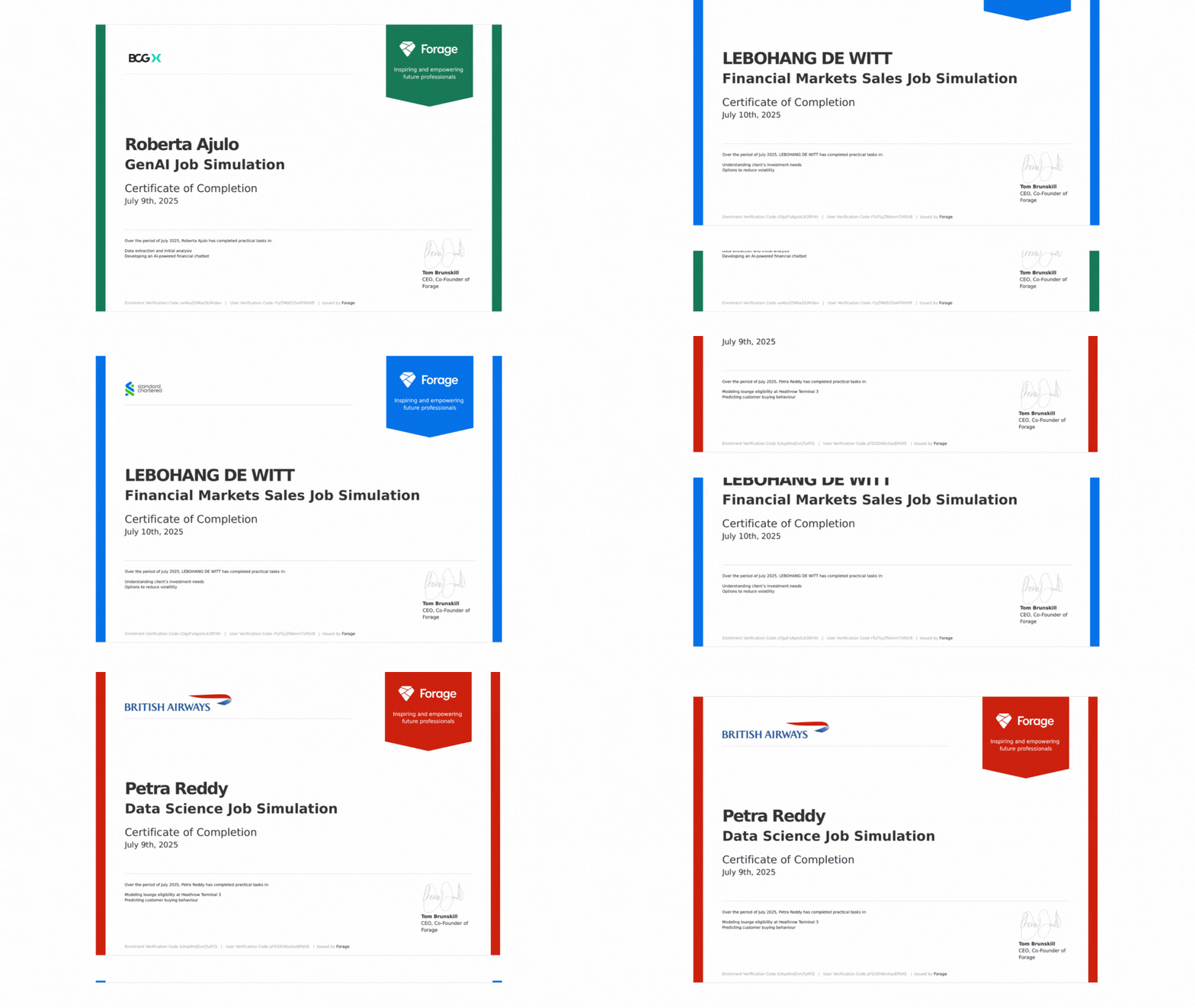
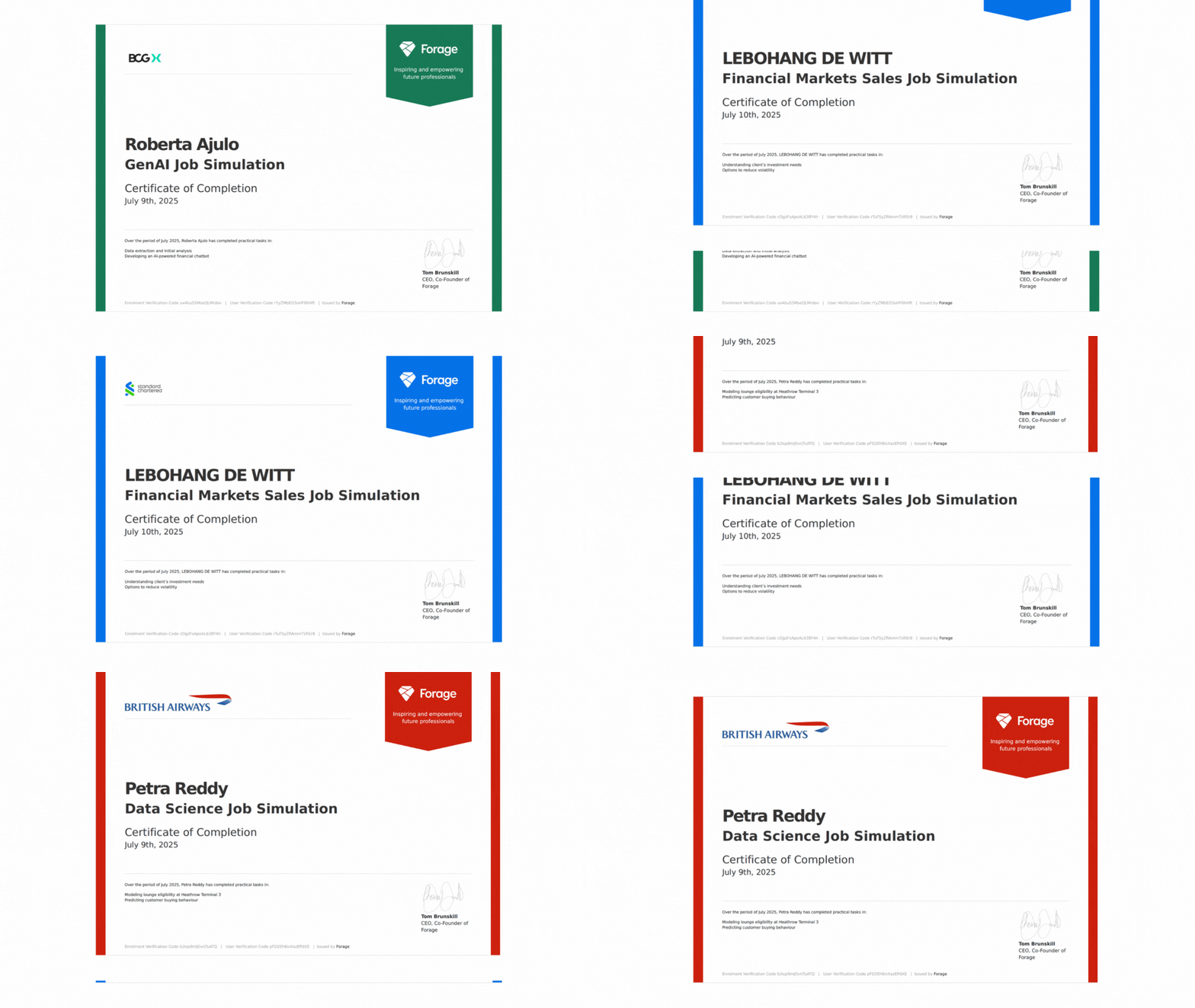
Real-world projects
Real-world projects
Build skills by doing. Every course includes hands-on projects that mirror real workplace challenges like building financial models, data dashboards, or marketing strategies. Projects are curated from the world's largest organizations.
Flexible


Flexible
Collaborative learning


Collaborative learning
Connect with peers and faculty
Personalized support


Personalized support
Get help when you need it
Technology enabled
Technology enabled
Learn with cutting-edge tools and platforms
Nexford is accredited.

Accredited by DEAC
Accredited by IACBE
Accredited by DEAC
Accredited by IACBE
Skills you will learn - and add to your résumé
Learn in-demand skills with our Malaysia BBA and MBA programs, which will expand your work opportunities and connect you to the global grid.

Build a Personal Brand
Craft a strong professional identity across resumes, LinkedIn, and interview settings.

Communicate in Business
Write clearly, present ideas, and collaborate effectively across teams and cultures internationally.

Use Business Data
Interpret and visualize data to support planning, marketing, and decision-making.

Understand Business Finances
Interpret budgets, reports, and financial statements to support sound business decisions.
Market a Product or Service
Use marketing tools to identify customer needs and promote value through digital channels.

Facilitate Team Collaboration
Use HR and communication tools to help teams align, solve problems, and perform better.
Build a Personal Brand
Craft a strong professional identity across resumes, LinkedIn, and interview settings.
Communicate in Business
Write clearly, present ideas, and collaborate effectively across teams and cultures internationally.
Use Business Data
Interpret and visualize data to support planning, marketing, and decision-making.
Understand Business Finances
Interpret budgets, reports, and financial statements to support sound business decisions.
Market a Product or Service
Use marketing tools to identify customer needs and promote value through digital channels.
Facilitate Team Collaboration
Use HR and communication tools to help teams align, solve problems, and perform better.
Courses in the Bachelor of Business Administration (BBA)
You’ll complete 40 courses – made up of general education courses, core courses, business electives, and elective courses that you can choose from. Courses are designed to take two months, but you can finish in just one. You’ll begin with one course at a time and can increase your course load as you progress.
Program Courses
Program Structure
You need 12 courses to complete your Bachelor of Business Administration (BBA)
11 general courses
15 core courses
3 elective courses or 3 specialization courses
1 capstone project
General Courses
Professional Communication

Professional Communication places an emphasis on communication styles and approaches in today's workplace to include digital, verbal and nonverbal communication. The course focuses on the evaluation of case analysis and discussion and on practical business and professional communication skills, including writing, speaking, and listening. Emphasis is on clarity, organization, format, appropriate language, and consideration of audience, for both written and oral communication. Learners engage in self-assessment of communicative competence and learn strategies for enhancing their skills. The course explores how technology and other tools are integrated into communications within a professional setting and students will be able to identify appropriate and inappropriate professional communications.
Intercultural Communication

Intercultural Communication exposes learners to the principles of intercultural communication to advance their efforts to understand and attribute meaning to communicative behaviors among different cultures and social groups. Learners study communication and culture, intercultural messages, the role of context in intercultural communication, the impact of culture on one’s identity, and communication style. Learners master the practical skills necessary to improve one’s intercultural communication competence in an international world.
Statistics

Statistics emphasizes the analysis of data collection and statistics through the use of current technology. This course introduces learners to statistical terms, distributions, displaying and interpreting of data collected (probability, validity and reliability), effect size, measures of central tendency (mean, median and mode) and determining statistical significance. Learners analyze hypothesis testing and apply statistical techniques.
Environmental Science

Environmental Science engages learners in examining how health and food is significantly impacted by the physical environment. Learners explore various topics within environmental science to include global warming, pollution, waste, and recycling. Learners examine how humans in increasingly industrialized countries, and the earth itself, are impacted by environmental pollutants and contaminants. This course reviews major environmental policies and their impact on the health of communities and the preservation of the earth or lack thereof. Learners discuss the scientific evidence of emerging environmental issues and the focus of the UN SDGs for 2030 is Sustainable Economic Development.
Nutrition and Wellness

Nutrition and Wellness focuses on highlighting strategies for a healthy lifestyle. Two changes have led to a significant increase in preventable diseases: a global increase in the consumption of heavily processed food, and cultural shifts in many parts of the world where people are moving away from preparing food at home. Learners are equipped with practical skills to be healthier consumers of food and consider the importance of a wellness lifestyle with an emphasis on self-responsibility, physical fitness, stress management, and environmental sensitivity. A key focus of UN SDGs for 2030 is Sustainable Economic Development.
Problem Solving & Critical Thinking

Problem Solving and Critical Thinking considers how most successful professionals of the 21st century will be able to assess an environment, analyze a situation, design alternative solutions, and assist organizations in creatively overcoming challenges and reaching strategic goals.
This course focuses on the development of reasoning and problem-solving skills by using the scientific method to analyze case studies and controversial topics. Learners consider cultural differences in reasoning, inductive and deductive logic, and how to use positive inquiry and synthesis to solve individual and organizational problems. Emphasis is placed on successful models and proven methods that are transferable within the work environment.
Science of Happiness

Science of Happiness offers evidence-based approaches to living a more meaningful, successful, and happy life by applying practical strategies to improve every domain of life, including home, work, and community. Despite the enormous hardships that many people face around the world, this course explores how to manage cognitive biases and the impact a positive mindset can have on personal, biological, relational, cultural and global aspects of life. Learners implement strategies which foster a positive behavior change.
American Institutions and Culture

American Institutions and Culture focuses on the US as an intricate subject of study, providing a foundation for examining and interpreting the unique economic and cultural impact of the US across the world. This course examines the US throughout its history and currently on the world stage, provides learners with a practical literacy of the features of American institutions and businesses along with a cultural framework for a fundamental understanding of this nation and prepares learners for the skills to work within an American business environment.
Cultural Aesthetic Understanding

Cultural Aesthetic Understanding focuses on concepts and theories involved in intercultural, interdisciplinary study of artistic influence and expression. Learners examine interactions among an assortment of modes of creative expression, role of style in daily life, performative representation of cultural identity and difference, and interaction of diverse artistic traditions.
Introduction to Spreadsheets and Modeling

Introduction to Spreadsheets and Modeling is designed to equip learners with foundational skills in spreadsheet usage and basic modeling techniques. In today’s data-driven world, the ability to efficiently organize, analyze, and visualize information is essential for success across various fields, including business, finance, engineering, and the sciences.
Decoding the Digital Consumer

This course explores the psychological principles underlying consumer behavior in the digital age. Learners will gain insights into how consumers perceive, process, and respond to marketing messages and sales interactions in online and offline environments. Through real-world case studies and interactive exercises, learners will learn to apply these principles to develop effective sales strategies, build rapport with customers, and influence purchasing decisions.
Core Courses (8 required)
Roadmap to Success

Roadmap to success is the foundational course for the Business program. This course prepares learners for success in the degree program and promotes a journey toward lifelong learning. Learners develop skills for communication, academic writing, self-discovery, career development, and presentation skills. This course is a hybrid competency course and introduces the learner to the competency-based model of Nexford courses in the BBA program.
The World of Business

The World of Business introduces the domain of business and key elements of the functional areas within the context that an organization operates. Learners examine a variety of functional areas and types of business in order to understand their interconnectedness. Additional topics include the business cycle, global business practices, and impact on productivity.
Marketing Fundamentals

Marketing Fundamentals is the foundational course for the Marketing specialization and is an introduction to the role of marketing in advancing the success of a product, service, experience or organization. Learners explore the evolution of marketing to include a review of the key marketing principles relevant in today’s workplace, an overview of the evolution from the traditional to digital marketing platform, and the differentiation between marketing a product or service versus marketing an experience. Learners examine functions and trends that are critical to staying competitive in the marketplace. This course introduces the functions of an organization for creating, communicating, and delivering value to customers. Designed to meet customers’ needs and organizational goals, these functions include marketing and behavioral science research, environmental monitoring, target market selection, product selection, promotion, distribution and pricing.
Introduction to Business Law

Introduction to Business Law engages learners in understanding how laws, rules, regulations, and ethical standards pervade every area of business. This course provides an overview of US law while considering that nearly all business concerns are global in nature in today’s ever-changing political and economic business environment. This course encourages learners to approach legal scenarios with an eye on international application. Learners apply several key legal concepts to situations based on real-world legal conundrums and cases. Topics include, but are not limited to contract law, business organization setup, employment law and intellectual property law. Learners thoroughly review and research legal concepts and apply knowledge to specific sets of legal issues found in the assigned professional scenarios.
Principles of Management

Principles of Management focuses on how to create a personal and shared vision and communicate effectively with teams as a leader, manager, and team member. Topics include how to set effective goals and expectations, understanding cultures, the difference between management and leadership, team membership and leadership, and the global workplace.
Financial Accounting

Financial Accounting focuses on the foundations of financial accounting concepts and methods used to generate, analyze, and interpret financial statements. Learners perform journal entries and record-keeping of transactions with an understanding of how these accounts are measured and reported in major financial statements.
Managerial Accounting and Cost Analysis

Managerial Accounting and Cost Analysis focuses on the techniques managers use to identify and manage production costs for labor, material, and overhead. Learners engage multiple methods for budgeting and cost reporting and calculate and interpret variances between budgets and actual results
Data Analytics

Advances in data collection, machine learning, and computational power have fueled institutional progress. The volume of available data has grown exponentially, and algorithms have continued to advance along with greater computational power and storage. As organizations become more inundated with data, having systems and processes in place to better understand and interpret data is highly important. This course focuses on how organizations can identify, evaluate and use data effectively. As consumers become increasingly savvy with their use of data, organizations need to change their responses. The use of data for all types of business from a large organization to a small retail shop will continue to become more sophisticated. This course provides an understanding of the data analysis process. Learners examine how technology has improved the ability to collect, analyze and interpret data, and they investigate data analysis tools and technologies to improve the decision making process.
Introduction to AI

The Introduction to AI course introduces the fundamental concepts of AI, exploring its transformative impact across industries. Learners examine various AI tools and technologies and their interconnected applications in business, healthcare, education, and manufacturing. Additional topics include the ethical implications of AI, future trends, and strategies for integrating AI into decision-making and operations effectively.
Principles of Macroeconomics

This course delves into the fascinating world of macroeconomics, giving learners the tools to understand the big picture of how economies function through general economic factors. Learners will cover GDP, consumption, investment, government role, causes and consequences of economics and busts, inflation and deflation, business cycles, and global connections. Learners will gain skills in economic data, policy impacts, data modeling, and international economics.
Principles of Microeconomics
Microeconomics course unlocks the secrets behind how individuals and businesses make decisions in today's dynamic market. After completing this course, learners will be able to analyze real-world problems according to economic theory, understand concepts such as supply, demand, costs and profits, and explore the impact of economic policies on human behavior.
Managing People Resources

This course provides an in-depth survey of concepts, skills, and practices in human resource management. Learners are introduced to innovative approaches in human capital management at the local, national, and global levels
Business Career Branding for Success

The Business Career Branding for Success course engages learners in developing and strengthening the business and personal component of one’s own career brand. The learner takes the role of a personal CEO and uses business tools to analyze competitive strengths and weaknesses, create a competency profile, document high-demand marketable and transferable skills, craft a resume, and develop a lifelong learning and career development plan that will be revisited throughout the degree program. This course is divided into two parts: Part one is completed when the learner first enrolls to establish a competitive benchmark pre-assessment and initial lifelong learning and career development action plan to be revisited throughout the program during specific course milestones, and Part two concludes in a capstone post-assessment that enables the learner to re-evaluate competitive strengths and weaknesses, finalize the lifelong learning and career development action plan, and create a personal brand and business plan for the individual career path. This course is continually available to learners to revisit and review throughout their studies at NXU from enrollment to graduation.
Applied Leadership

This course is designed to provide practical applications for leadership and management challenges and opportunities in the ever-changing environment of global business. Learners examine leadership and management from both a personal and an organizational perspective and apply principles and techniques in order to adapt to the environment in both roles.
International Business and Culture

International Business and Culture is the foundational course for International Business. As the speed of globalization increases, organizations need to be increasingly focused on an integrated global business and culture. This course focuses on international business and the interconnectedness of a global culture. Learners examine how an organization operating in the global environment needs to understand and appreciate how to best leverage both global and local cultures for responsible and successful business practices. Topics from the perspective of a global firm are related to management, leadership, the economy, financial reporting and regulatory compliance.
Elective Courses (3 required)
Strategic People Operations

Strategic People Operations prepares learners to apply the strategic management process from the Human Resource (HR) perspective. Learners examine how to manage talent effectively in the dynamic regulatory and competitive environment. The course emphasizes integrating human resource management concepts related to the formulation and implementation of HR strategy and practices to support the overall global business strategy.
Digital Marketing Fundamentals
Digital Marketing Fundamentals provides an understanding of the digital marketing landscape, key trends impacting the industry, the changed customer journey, and the role each channel can play in that journey. The course also examines the advantages and subsequent challenges of this expanding marketing venue. Learners explore the tools that currently exist and the potential for future applications of the digital platform for marketing purpose. The course will further explore the digital platform as a tool for businesses in general in order to increase its levels of efficiency, effectiveness, and competitive position in the market space. Learners define and develop a digital strategy to help a business achieve its goals.
Content Marketing and Social Media

Content Marketing and Social Media emphasizes the importance of content and how different content types can be used to support brand and business goals. Learners identify not only the content type, but the literal content as well, in conjunction with a focus on the most appropriate demographic(s) for various content. Additionally, learners develop a content strategy and create engaging content for the right audience and channel.
Auditing and Assurance Services

Auditing and Assurance Services focuses on how to plan and conduct an audit of a company’s financial statements and examines the importance of assurance services to users of financial statements. Learners apply techniques to identify and analyze evidence, identify fraud, and determine and publish an opinion report of the auditor’s findings.
Introduction to Entrepreneurship

Introduction to Entrepreneurship introduces learners to the concept of entrepreneurship by exploring the Lean Startup movement to help frame what a startup is and how learners can approach new markets and businesses from a product perspective. Learners evaluate a business idea, assess its viability in a broader market, and create a simple prototype to test the idea with customers.
Fundamentals of Financial Management

Financial Management focuses on the foundations of finance concepts required to be capable of managing day to day financial operations and to solve complex financial matters. Learners examine the elements of financial statements of an entity and impact of changes in one element on the other. Additionally, learners plan and control cash flows and make decisions in the microeconomic and macroeconomic environment.
Corporate Finance and Investment Analysis

Corporate Finance and Investment Analysis focuses on financial skills and analytical methods for corporate finance managers and investment analysts. Topics include corporate financial analysis, acquisition and allocation of capital, and financial statement reporting, as well as an exposure to investing in major asset classes, measures of risk and return, and methods for valuing equity and debt.
Corporate Tax Strategies

Corporate Tax Strategies focuses on strategies for corporations to legally minimize their tax liabilities. Learners learn analyze financial transactions, calculate realized gains and losses, and determine whether to recognize gains and losses now or in the future.
Project Management

Project Management highlights a key tool for any organization, which is the ability to manage multiple projects simultaneously to achieve positive results. This course examines from an organizational perspective the tasks associated with project management. The focus is on the four components of the project life-cycle in an international business setting: organizing, planning, monitoring, and controlling. Learners identify and apply relevant project management tools and methods designed to execute projects in an effective manner that maximizes efficiency and minimizes cost.
Staffing and Development
Staffing and Development encompasses the activities involved in building and maintaining a workforce that meets the needs of the organization. The focus is on managing talent during recruitment, selection, retention, and development. Learners develop a plan to identify individual and organizational needs within the appropriate regulatory framework.
Organizational Relationships

Organizational Relationships examines the interrelationships between business, government and society. Learners gain an understanding of how each of these entities contributes to the overall success of the organization, and if one of these areas is not in sync with the other two, the organization may not achieve its goals. Learners examine the interconnectedness of these three areas through topics of corporate social responsibility, business ethics, the regulatory climate, globalization, and the environment. A key focus of this course is connections between the developed and emerging markets. Learners examine how these markets rely on each other from multiple perspectives, including economics, culture, trade, human capital, and so on.
Marketing Strategy and Planning

Marketing Strategy and Planning provides learners with the opportunity to develop and master competencies required to execute marketing strategy. Learners perfect skills for planning and implementing a marketing strategy, including evaluating current brand positioning in the marketplace, identifying target audiences, setting objectives and key performance indicators (KPIs), and defining evaluation metrics to determine effectiveness. Key elements of strategic planning are examined, including pricing, brand positioning, and setting up the framework of a strategic marketing plan.
Compensation & Benefits

Compensation & Benefits examines the development and administration of compensation and benefit practices, as well as challenges faced in managing total rewards in the multigenerational, competitive global economy. Learners analyze the strategic components of pay structures and reward systems, and the impact on employees and the organization.
Fundamentals of Digital Transformation

Fundamentals of Digital Transformation is the foundational course for the Digital Transformation specialization. This course provides a survey of three types of capability transformations that enable digital transformation: people, tool, and process. At the people capability level, digital transformation requires the organization to hire and retain customer-centric and service-oriented talent; this talent search demands more collaboration and knowledge sharing while breaking down the silos between business and technology. At the tool capability level, a horizontal digital enabling layer is required to be developed, covering big data analytics, artificial intelligence, robotics, IoT, wearables, augmented and artificial reality, and modular manufacturing. Vertical business applications require digitization by the horizontal digital enablers in vertical business applications such as supply chain management, customer experience, finance and administration, and more. At the process capability level, digital transformation requires the business processes to be automated via the horizontal digital enablers.
Process & Quality Management

This course equips learners with the knowledge and skills to analyze, improve, and manage business processes, with a focus on achieving operational excellence. Learners will learn to apply Lean Six Sigma methodologies, quality management tools, and data analysis techniques to optimize workflows, reduce costs, and enhance customer satisfaction. The course culminates in Yellow Belt and Green Belt certifications, validating learners' expertise in process improvement and quality management.
Professional Selling and Relationship Management

This course will provide learners with a comprehensive and practical exploration of the professional selling process, enabling them to master the art of building and sustaining long-lasting customer relationships. Learners will gain a deep understanding of the seven steps of the selling process, from prospecting and qualifying to closing the sale and follow-up. They will develop key skills in communication, active listening, adaptive selling, and ethical decision-making, empowering them to effectively identify and address customer needs, build rapport, and achieve sales goals while adhering to ethical standards.
Digital Selling and E-commerce Strategies

This course explores the evolving landscape of professional selling in the digital age. Learners will learn how e-commerce has transformed sales practices across B2B, B2C, and other market segments. The course covers key concepts of e-commerce, including online sales platforms, digital marketing integration, customer relationship management (CRM) in the digital context, and data analytics for sales optimization. Learners will develop practical skills in online sales techniques, digital communication, and building customer relationships in a virtual environment. The course emphasizes a hands-on approach, incorporating case studies, simulations, and projects that simulate real-world e-commerce sales scenarios.
Marketing Channels, Tactics and Management

The Marketing Channels, Tactics, and Management course examines the contemporary range of marketing channels, common tactics unique to various channels, and how to plan an integrated approach to reach consumers at critical points. This course provides an overview of marketing channels with more focus on digital channels covered throughout the Digital Marketing specialization. To deliver on the core components of any brand’s success, customers and stakeholders must feel assured that the brand exists, be clear on its offering, and see clear value in relation to themselves. Based on rapid changes in technology along with the way we distribute, consume and share media, understanding channel differentiators and designing an integrated marketing approach are essential for business goal attainment in today’s competitive landscape.
Digital Advertising and Search Engine Optimization

Digital Advertising and Search Engine Optimization provides an understanding of the different performance marketing channels and how they can help a business grow traffic quickly and sustainably. Learners set up campaigns and develop strategies to optimize for performance.
Digital Marketing Analytics

Digital Marketing Analytics provides emphasizes the importance of data and analytics in today’s business environment. Learners measure digital marketing activity performance, set up dashboards using tools such as Google Analytics, and report on the results of data analysis.
Product and Marketing Skills for Founders

Product and Marketing Skills for Founders introduces learners to foundational product and marketing skills that are relevant to building and launching a tech startup. This course builds on concepts of Lean Startup to enable learners to refine their business ideas by gathering reliable customer feedback. Learners are introduced to fundamental concepts in product design.
Technical Skills for Non-Technical Founders

echnical Founders - Technical Skills for Non-Technical Founders examines the technical foundation of digital product development and design. Learners are exposed to the various technical components of a product and develop a framework for vetting technical business partners.
Founders, Financing, and Legal

Founders, Financing, and Legal prepares learners for the business and legal realities of launching and growing a startup. Learners evaluate the importance of a cofounder, explore the process and need for pitching and raising investor funds, analyze the value of various legal structures, and examine how equity and compensation are unique to startups.
Introduction to AI
The Introduction to AI course introduces the fundamental concepts of AI, exploring its transformative impact across industries. Learners examine various AI tools and technologies and their interconnected applications in business, healthcare, education, and manufacturing. Additional topics include the ethical implications of AI, future trends, and strategies for integrating AI into decision-making and operations effectively.
Machine Learning and Predictive Analytics

Machine Learning and Predictive Analytics helps learners understand how in today’s global business markets organizations have the opportunity to reach a wider consumer base for their products, and as this consumer base expands, the need for a more sophisticated approach to data mining, analysis, and application is increasingly evident. This course focuses on the use of predictive analytics and the use of machine learning to find patterns in data sets; the organizations that can better understand the data they collect along with being able to make predictive calculations from that data will gain competitive advantages in their respective markets. In this course learners examine the tools and techniques of predictive analytics and machine learning, including regression analysis, decision trees, and rule models. Learners gain a better understanding of how to predict outcomes from available data. Learners explore and examine data, apply predictive tools and techniques to predict outcomes from the data, and interpret the results for improved decision making.
Foundations of Robotics and IoT

Foundations of Robotics and IoT engages learners in understanding how the interconnectivity of devices via the Internet is harnessed to improve robotic manufacturing processes. This course provides an overview of IoT architecture. Within the context of IoT ecosystems, learners explore software product design with cyber models, application modeling, IoT value modeling, and hardware product design with sensors, embedded systems, and connected sensors. Topics also include an overview of the network fabric in IoT, operational technology (OT), information technology (IT) and fog networks, IoT product cloud, and IoT platforms. This course provides an overview of intelligent process automation (IPA) and five major technologies supporting robotic process automation (RPA): smart workflow, machine learning, advanced analytics, natural-Language generation, and cognitive agents.
Fundamentals of Cybersecurity

Information is the lifeblood for organizations of all types. Therefore, everyone needs to have a fundamental understanding of the interdisciplinary field of cybersecurity. This course provides this fundamental knowledge by taking the learner through the evolution of discipline from information security to cybersecurity. Learners evaluate several important laws, which have significant impact on cybersecurity strategy. Learners also investigate multiple cybersecurity technologies, processes, and procedures and learn how to analyze threats, vulnerabilities, and risks in these environments, and develop appropriate mitigation strategies by applying a mission-focused and risk-optimized approach. This survey course introduces learners to the three primary sources of threats (technology, policy, and people, both internal and external) and the three classes of tools (technology, policy, and people) used to develop an organizational cybersecurity strategy. This course and exercises are designed to emphasize, encourage and enhance the critical thinking abilities of learners. Although the course is not designed to prepare learners for this test, the material covered in this course includes most of the knowledge tested in the CompTIA Security+ exam. Learners will apply their learning by performing systematic case studies of actual organizations.
Data Analytics
Advances in data collection, machine learning, and computational power have fueled institutional progress. The volume of available data has grown exponentially, and algorithms have continued to advance along with greater computational power and storage. As organizations become more inundated with data, having systems and processes in place to better understand and interpret data is highly important. This course focuses on how organizations can identify, evaluate and use data effectively. As consumers become increasingly savvy with their use of data, organizations need to change their responses. The use of data for all types of business from a large organization to a small retail shop will continue to become more sophisticated. This course provides an understanding of the data analysis process. Learners examine how technology has improved the ability to collect, analyze and interpret data, and they investigate data analysis tools and technologies to improve the decision making process.
Data Analysis and Visualization

Data Analysis and Visualization helps learners understand how organizations collect, mine, analyze, and interpret data, and how it is important for organizations to understand their stakeholders and customize their data accordingly. At all levels of the organization, especially at the senior level, data must meet the needs of various stakeholders. In this course learners gain an understanding of how to use data analysis and visualization tools and techniques. Learners also acquire the fundamental skills for data analysis and visualization by examining and applying various tools and techniques including MS-Excel, Tableau, and Python to develop dashboards. Learners examine data, apply analysis and visualization tools, and leverage advanced techniques to display outcomes and interpret the results for improved decision making.
Agile Leadership

Agile Leadership focuses on the soft skills a manager needs to effectively communicate with different teams and management. The focus is on how a manager plays the role of mediator between different organizations with different priorities.
Introduction to Supply Chain Management

Introduction to Supply Chain Management is the first course in the Supply-Chain specialization. Learners examine how, as the world becomes more automated along with an increased use of sophisticated technologies, the traditional supply chain is set to evolve. The digital transformation of the supply chain will have an impact on supply agility as well as on the dimensions of costs, capital and service offerings. The ability to be adaptable, flexible, and integrated with technology are defining concepts for future supply chains. As supply moves forward, digital transformation will impact key supply function including: the physical flow of goods, warehouse automation, and smart logistics planning. Organizations such as Amazon, Wal-Mart, and Alibaba have complex supply chains that incorporate advanced technologies such as AI and robotics. Each of these organizations has revolutionized and re-shaped the approach to both logistics and supply chain management. A supply chain risk management strategy must now include considerations for non-traditional risks such as cyber attacks, biological attacks, and political attacks. In this course learners are provided with an overview of the field of supply chain management including the logistics management functions and the interrelationships among the different organizational functions. Learners examine effective supply chain strategies and logistics functions from a global perspective.
Governance and Law for Intelligent Systems
/Program%20courses/Webp%20assets/founders%20financing%20legal_webp.webp)
This course provides an advanced, analytical examination of the legal and policy frameworks governing digital businesses and technology deployment. It moves beyond foundational contracts into the areas where modern technology actually creates exposure: data ownership, intellectual property, and regulatory compliance built around real frameworks like GDPR and CCPA. Learners analyze the legal implications of developing and deploying automated and AI-driven systems in a business context, then dig into the thorny questions of digital intellectual property — including the unsettled territory of rights over software, data, and generative AI content. The orientation is practical and strategic throughout: not law as abstraction, but law as a business risk to be managed.
From there, the course builds the judgment to turn regulation into strategy. Learners interpret global data privacy regulations and governance standards to formulate organizational compliance strategies, and examine the contractual and legal risks that come with cloud services, API usage, and third-party data reliance. A dedicated focus on algorithmic bias and data discrimination pushes learners to formulate governance policies that mitigate genuine legal and ethical risk — not just check a compliance box. Working through real legal case studies and precedents, learners learn to evaluate how law and governance actually apply in the digital economy. By the end, they can build governance and compliance strategies robust enough to stand behind a real technology initiative.
Capstone project (1 required)
Strategy and Organizational Planning

Strategy and Organizational Planning is the capstone course in the BBA program and examines how organizations set strategy and planning as key drivers of organizational success. In any domestic or international setting, the functions of strategy and planning are valuable resources in maintaining or expanding the competitive position. This course encourages learners to take a long-term view of the roles of strategy and planning whose concepts form the foundation for the practice of strategic management. Key topics covered include strategy analysis, strategic planning, and strategy implementation and evaluation. Both strategy and planning are boundaryless functions, thus allowing learners to examine these topics from the perspective of organizations operating in emerging markets.
You need 12 courses to complete your Bachelor of Business Administration (BBA)
11 general courses
15 core courses
3 elective courses or 3 specialization courses
1 capstone project
Professional Communication
Professional Communication places an emphasis on communication styles and approaches in today's workplace to include digital, verbal and nonverbal communication. The course focuses on the evaluation of case analysis and discussion and on practical business and professional communication skills, including writing, speaking, and listening. Emphasis is on clarity, organization, format, appropriate language, and consideration of audience, for both written and oral communication. Learners engage in self-assessment of communicative competence and learn strategies for enhancing their skills. The course explores how technology and other tools are integrated into communications within a professional setting and students will be able to identify appropriate and inappropriate professional communications.
Intercultural Communication
Intercultural Communication exposes learners to the principles of intercultural communication to advance their efforts to understand and attribute meaning to communicative behaviors among different cultures and social groups. Learners study communication and culture, intercultural messages, the role of context in intercultural communication, the impact of culture on one’s identity, and communication style. Learners master the practical skills necessary to improve one’s intercultural communication competence in an international world.
Statistics
Statistics emphasizes the analysis of data collection and statistics through the use of current technology. This course introduces learners to statistical terms, distributions, displaying and interpreting of data collected (probability, validity and reliability), effect size, measures of central tendency (mean, median and mode) and determining statistical significance. Learners analyze hypothesis testing and apply statistical techniques.
Environmental Science
Environmental Science engages learners in examining how health and food is significantly impacted by the physical environment. Learners explore various topics within environmental science to include global warming, pollution, waste, and recycling. Learners examine how humans in increasingly industrialized countries, and the earth itself, are impacted by environmental pollutants and contaminants. This course reviews major environmental policies and their impact on the health of communities and the preservation of the earth or lack thereof. Learners discuss the scientific evidence of emerging environmental issues and the focus of the UN SDGs for 2030 is Sustainable Economic Development.
Nutrition and Wellness
Nutrition and Wellness focuses on highlighting strategies for a healthy lifestyle. Two changes have led to a significant increase in preventable diseases: a global increase in the consumption of heavily processed food, and cultural shifts in many parts of the world where people are moving away from preparing food at home. Learners are equipped with practical skills to be healthier consumers of food and consider the importance of a wellness lifestyle with an emphasis on self-responsibility, physical fitness, stress management, and environmental sensitivity. A key focus of UN SDGs for 2030 is Sustainable Economic Development.
Problem Solving & Critical Thinking
Problem Solving and Critical Thinking considers how most successful professionals of the 21st century will be able to assess an environment, analyze a situation, design alternative solutions, and assist organizations in creatively overcoming challenges and reaching strategic goals.
This course focuses on the development of reasoning and problem-solving skills by using the scientific method to analyze case studies and controversial topics. Learners consider cultural differences in reasoning, inductive and deductive logic, and how to use positive inquiry and synthesis to solve individual and organizational problems. Emphasis is placed on successful models and proven methods that are transferable within the work environment.
Science of Happiness
Science of Happiness offers evidence-based approaches to living a more meaningful, successful, and happy life by applying practical strategies to improve every domain of life, including home, work, and community. Despite the enormous hardships that many people face around the world, this course explores how to manage cognitive biases and the impact a positive mindset can have on personal, biological, relational, cultural and global aspects of life. Learners implement strategies which foster a positive behavior change.
American Institutions and Culture
American Institutions and Culture focuses on the US as an intricate subject of study, providing a foundation for examining and interpreting the unique economic and cultural impact of the US across the world. This course examines the US throughout its history and currently on the world stage, provides learners with a practical literacy of the features of American institutions and businesses along with a cultural framework for a fundamental understanding of this nation and prepares learners for the skills to work within an American business environment.
Cultural Aesthetic Understanding
Cultural Aesthetic Understanding focuses on concepts and theories involved in intercultural, interdisciplinary study of artistic influence and expression. Learners examine interactions among an assortment of modes of creative expression, role of style in daily life, performative representation of cultural identity and difference, and interaction of diverse artistic traditions.
Introduction to Spreadsheets and Modeling
Introduction to Spreadsheets and Modeling is designed to equip learners with foundational skills in spreadsheet usage and basic modeling techniques. In today’s data-driven world, the ability to efficiently organize, analyze, and visualize information is essential for success across various fields, including business, finance, engineering, and the sciences.
Decoding the Digital Consumer
This course explores the psychological principles underlying consumer behavior in the digital age. Learners will gain insights into how consumers perceive, process, and respond to marketing messages and sales interactions in online and offline environments. Through real-world case studies and interactive exercises, learners will learn to apply these principles to develop effective sales strategies, build rapport with customers, and influence purchasing decisions.
Roadmap to Success
Roadmap to success is the foundational course for the Business program. This course prepares learners for success in the degree program and promotes a journey toward lifelong learning. Learners develop skills for communication, academic writing, self-discovery, career development, and presentation skills. This course is a hybrid competency course and introduces the learner to the competency-based model of Nexford courses in the BBA program.
The World of Business
The World of Business introduces the domain of business and key elements of the functional areas within the context that an organization operates. Learners examine a variety of functional areas and types of business in order to understand their interconnectedness. Additional topics include the business cycle, global business practices, and impact on productivity.
Marketing Fundamentals
Marketing Fundamentals is the foundational course for the Marketing specialization and is an introduction to the role of marketing in advancing the success of a product, service, experience or organization. Learners explore the evolution of marketing to include a review of the key marketing principles relevant in today’s workplace, an overview of the evolution from the traditional to digital marketing platform, and the differentiation between marketing a product or service versus marketing an experience. Learners examine functions and trends that are critical to staying competitive in the marketplace. This course introduces the functions of an organization for creating, communicating, and delivering value to customers. Designed to meet customers’ needs and organizational goals, these functions include marketing and behavioral science research, environmental monitoring, target market selection, product selection, promotion, distribution and pricing.
Introduction to Business Law
Introduction to Business Law engages learners in understanding how laws, rules, regulations, and ethical standards pervade every area of business. This course provides an overview of US law while considering that nearly all business concerns are global in nature in today’s ever-changing political and economic business environment. This course encourages learners to approach legal scenarios with an eye on international application. Learners apply several key legal concepts to situations based on real-world legal conundrums and cases. Topics include, but are not limited to contract law, business organization setup, employment law and intellectual property law. Learners thoroughly review and research legal concepts and apply knowledge to specific sets of legal issues found in the assigned professional scenarios.
Principles of Management
Principles of Management focuses on how to create a personal and shared vision and communicate effectively with teams as a leader, manager, and team member. Topics include how to set effective goals and expectations, understanding cultures, the difference between management and leadership, team membership and leadership, and the global workplace.
Financial Accounting
Financial Accounting focuses on the foundations of financial accounting concepts and methods used to generate, analyze, and interpret financial statements. Learners perform journal entries and record-keeping of transactions with an understanding of how these accounts are measured and reported in major financial statements.
Managerial Accounting and Cost Analysis
Managerial Accounting and Cost Analysis focuses on the techniques managers use to identify and manage production costs for labor, material, and overhead. Learners engage multiple methods for budgeting and cost reporting and calculate and interpret variances between budgets and actual results
Data Analytics
Advances in data collection, machine learning, and computational power have fueled institutional progress. The volume of available data has grown exponentially, and algorithms have continued to advance along with greater computational power and storage. As organizations become more inundated with data, having systems and processes in place to better understand and interpret data is highly important. This course focuses on how organizations can identify, evaluate and use data effectively. As consumers become increasingly savvy with their use of data, organizations need to change their responses. The use of data for all types of business from a large organization to a small retail shop will continue to become more sophisticated. This course provides an understanding of the data analysis process. Learners examine how technology has improved the ability to collect, analyze and interpret data, and they investigate data analysis tools and technologies to improve the decision making process.
Introduction to AI
The Introduction to AI course introduces the fundamental concepts of AI, exploring its transformative impact across industries. Learners examine various AI tools and technologies and their interconnected applications in business, healthcare, education, and manufacturing. Additional topics include the ethical implications of AI, future trends, and strategies for integrating AI into decision-making and operations effectively.
Principles of Macroeconomics
This course delves into the fascinating world of macroeconomics, giving learners the tools to understand the big picture of how economies function through general economic factors. Learners will cover GDP, consumption, investment, government role, causes and consequences of economics and busts, inflation and deflation, business cycles, and global connections. Learners will gain skills in economic data, policy impacts, data modeling, and international economics.
Principles of Microeconomics
Microeconomics course unlocks the secrets behind how individuals and businesses make decisions in today's dynamic market. After completing this course, learners will be able to analyze real-world problems according to economic theory, understand concepts such as supply, demand, costs and profits, and explore the impact of economic policies on human behavior.
Managing People Resources
This course provides an in-depth survey of concepts, skills, and practices in human resource management. Learners are introduced to innovative approaches in human capital management at the local, national, and global levels
Business Career Branding for Success
The Business Career Branding for Success course engages learners in developing and strengthening the business and personal component of one’s own career brand. The learner takes the role of a personal CEO and uses business tools to analyze competitive strengths and weaknesses, create a competency profile, document high-demand marketable and transferable skills, craft a resume, and develop a lifelong learning and career development plan that will be revisited throughout the degree program. This course is divided into two parts: Part one is completed when the learner first enrolls to establish a competitive benchmark pre-assessment and initial lifelong learning and career development action plan to be revisited throughout the program during specific course milestones, and Part two concludes in a capstone post-assessment that enables the learner to re-evaluate competitive strengths and weaknesses, finalize the lifelong learning and career development action plan, and create a personal brand and business plan for the individual career path. This course is continually available to learners to revisit and review throughout their studies at NXU from enrollment to graduation.
Applied Leadership
This course is designed to provide practical applications for leadership and management challenges and opportunities in the ever-changing environment of global business. Learners examine leadership and management from both a personal and an organizational perspective and apply principles and techniques in order to adapt to the environment in both roles.
International Business and Culture
International Business and Culture is the foundational course for International Business. As the speed of globalization increases, organizations need to be increasingly focused on an integrated global business and culture. This course focuses on international business and the interconnectedness of a global culture. Learners examine how an organization operating in the global environment needs to understand and appreciate how to best leverage both global and local cultures for responsible and successful business practices. Topics from the perspective of a global firm are related to management, leadership, the economy, financial reporting and regulatory compliance.
Strategic People Operations
Strategic People Operations prepares learners to apply the strategic management process from the Human Resource (HR) perspective. Learners examine how to manage talent effectively in the dynamic regulatory and competitive environment. The course emphasizes integrating human resource management concepts related to the formulation and implementation of HR strategy and practices to support the overall global business strategy.
Digital Marketing Fundamentals
Digital Marketing Fundamentals provides an understanding of the digital marketing landscape, key trends impacting the industry, the changed customer journey, and the role each channel can play in that journey. The course also examines the advantages and subsequent challenges of this expanding marketing venue. Learners explore the tools that currently exist and the potential for future applications of the digital platform for marketing purpose. The course will further explore the digital platform as a tool for businesses in general in order to increase its levels of efficiency, effectiveness, and competitive position in the market space. Learners define and develop a digital strategy to help a business achieve its goals.
Content Marketing and Social Media
Content Marketing and Social Media emphasizes the importance of content and how different content types can be used to support brand and business goals. Learners identify not only the content type, but the literal content as well, in conjunction with a focus on the most appropriate demographic(s) for various content. Additionally, learners develop a content strategy and create engaging content for the right audience and channel.
Auditing and Assurance Services
Auditing and Assurance Services focuses on how to plan and conduct an audit of a company’s financial statements and examines the importance of assurance services to users of financial statements. Learners apply techniques to identify and analyze evidence, identify fraud, and determine and publish an opinion report of the auditor’s findings.
Introduction to Entrepreneurship
Introduction to Entrepreneurship introduces learners to the concept of entrepreneurship by exploring the Lean Startup movement to help frame what a startup is and how learners can approach new markets and businesses from a product perspective. Learners evaluate a business idea, assess its viability in a broader market, and create a simple prototype to test the idea with customers.
Fundamentals of Financial Management
Financial Management focuses on the foundations of finance concepts required to be capable of managing day to day financial operations and to solve complex financial matters. Learners examine the elements of financial statements of an entity and impact of changes in one element on the other. Additionally, learners plan and control cash flows and make decisions in the microeconomic and macroeconomic environment.
Corporate Finance and Investment Analysis
Corporate Finance and Investment Analysis focuses on financial skills and analytical methods for corporate finance managers and investment analysts. Topics include corporate financial analysis, acquisition and allocation of capital, and financial statement reporting, as well as an exposure to investing in major asset classes, measures of risk and return, and methods for valuing equity and debt.
Corporate Tax Strategies
Corporate Tax Strategies focuses on strategies for corporations to legally minimize their tax liabilities. Learners learn analyze financial transactions, calculate realized gains and losses, and determine whether to recognize gains and losses now or in the future.
Project Management
Project Management highlights a key tool for any organization, which is the ability to manage multiple projects simultaneously to achieve positive results. This course examines from an organizational perspective the tasks associated with project management. The focus is on the four components of the project life-cycle in an international business setting: organizing, planning, monitoring, and controlling. Learners identify and apply relevant project management tools and methods designed to execute projects in an effective manner that maximizes efficiency and minimizes cost.
Staffing and Development
Staffing and Development encompasses the activities involved in building and maintaining a workforce that meets the needs of the organization. The focus is on managing talent during recruitment, selection, retention, and development. Learners develop a plan to identify individual and organizational needs within the appropriate regulatory framework.
Organizational Relationships
Organizational Relationships examines the interrelationships between business, government and society. Learners gain an understanding of how each of these entities contributes to the overall success of the organization, and if one of these areas is not in sync with the other two, the organization may not achieve its goals. Learners examine the interconnectedness of these three areas through topics of corporate social responsibility, business ethics, the regulatory climate, globalization, and the environment. A key focus of this course is connections between the developed and emerging markets. Learners examine how these markets rely on each other from multiple perspectives, including economics, culture, trade, human capital, and so on.
Marketing Strategy and Planning
Marketing Strategy and Planning provides learners with the opportunity to develop and master competencies required to execute marketing strategy. Learners perfect skills for planning and implementing a marketing strategy, including evaluating current brand positioning in the marketplace, identifying target audiences, setting objectives and key performance indicators (KPIs), and defining evaluation metrics to determine effectiveness. Key elements of strategic planning are examined, including pricing, brand positioning, and setting up the framework of a strategic marketing plan.
Compensation & Benefits
Compensation & Benefits examines the development and administration of compensation and benefit practices, as well as challenges faced in managing total rewards in the multigenerational, competitive global economy. Learners analyze the strategic components of pay structures and reward systems, and the impact on employees and the organization.
Fundamentals of Digital Transformation
Fundamentals of Digital Transformation is the foundational course for the Digital Transformation specialization. This course provides a survey of three types of capability transformations that enable digital transformation: people, tool, and process. At the people capability level, digital transformation requires the organization to hire and retain customer-centric and service-oriented talent; this talent search demands more collaboration and knowledge sharing while breaking down the silos between business and technology. At the tool capability level, a horizontal digital enabling layer is required to be developed, covering big data analytics, artificial intelligence, robotics, IoT, wearables, augmented and artificial reality, and modular manufacturing. Vertical business applications require digitization by the horizontal digital enablers in vertical business applications such as supply chain management, customer experience, finance and administration, and more. At the process capability level, digital transformation requires the business processes to be automated via the horizontal digital enablers.
Process & Quality Management
This course equips learners with the knowledge and skills to analyze, improve, and manage business processes, with a focus on achieving operational excellence. Learners will learn to apply Lean Six Sigma methodologies, quality management tools, and data analysis techniques to optimize workflows, reduce costs, and enhance customer satisfaction. The course culminates in Yellow Belt and Green Belt certifications, validating learners' expertise in process improvement and quality management.
Professional Selling and Relationship Management
This course will provide learners with a comprehensive and practical exploration of the professional selling process, enabling them to master the art of building and sustaining long-lasting customer relationships. Learners will gain a deep understanding of the seven steps of the selling process, from prospecting and qualifying to closing the sale and follow-up. They will develop key skills in communication, active listening, adaptive selling, and ethical decision-making, empowering them to effectively identify and address customer needs, build rapport, and achieve sales goals while adhering to ethical standards.
Digital Selling and E-commerce Strategies
This course explores the evolving landscape of professional selling in the digital age. Learners will learn how e-commerce has transformed sales practices across B2B, B2C, and other market segments. The course covers key concepts of e-commerce, including online sales platforms, digital marketing integration, customer relationship management (CRM) in the digital context, and data analytics for sales optimization. Learners will develop practical skills in online sales techniques, digital communication, and building customer relationships in a virtual environment. The course emphasizes a hands-on approach, incorporating case studies, simulations, and projects that simulate real-world e-commerce sales scenarios.
Marketing Channels, Tactics and Management
The Marketing Channels, Tactics, and Management course examines the contemporary range of marketing channels, common tactics unique to various channels, and how to plan an integrated approach to reach consumers at critical points. This course provides an overview of marketing channels with more focus on digital channels covered throughout the Digital Marketing specialization. To deliver on the core components of any brand’s success, customers and stakeholders must feel assured that the brand exists, be clear on its offering, and see clear value in relation to themselves. Based on rapid changes in technology along with the way we distribute, consume and share media, understanding channel differentiators and designing an integrated marketing approach are essential for business goal attainment in today’s competitive landscape.
Digital Advertising and Search Engine Optimization
Digital Advertising and Search Engine Optimization provides an understanding of the different performance marketing channels and how they can help a business grow traffic quickly and sustainably. Learners set up campaigns and develop strategies to optimize for performance.
Digital Marketing Analytics
Digital Marketing Analytics provides emphasizes the importance of data and analytics in today’s business environment. Learners measure digital marketing activity performance, set up dashboards using tools such as Google Analytics, and report on the results of data analysis.
Product and Marketing Skills for Founders
Product and Marketing Skills for Founders introduces learners to foundational product and marketing skills that are relevant to building and launching a tech startup. This course builds on concepts of Lean Startup to enable learners to refine their business ideas by gathering reliable customer feedback. Learners are introduced to fundamental concepts in product design.
Technical Skills for Non-Technical Founders
echnical Founders - Technical Skills for Non-Technical Founders examines the technical foundation of digital product development and design. Learners are exposed to the various technical components of a product and develop a framework for vetting technical business partners.
Founders, Financing, and Legal
Founders, Financing, and Legal prepares learners for the business and legal realities of launching and growing a startup. Learners evaluate the importance of a cofounder, explore the process and need for pitching and raising investor funds, analyze the value of various legal structures, and examine how equity and compensation are unique to startups.
Introduction to AI
The Introduction to AI course introduces the fundamental concepts of AI, exploring its transformative impact across industries. Learners examine various AI tools and technologies and their interconnected applications in business, healthcare, education, and manufacturing. Additional topics include the ethical implications of AI, future trends, and strategies for integrating AI into decision-making and operations effectively.
Machine Learning and Predictive Analytics
Machine Learning and Predictive Analytics helps learners understand how in today’s global business markets organizations have the opportunity to reach a wider consumer base for their products, and as this consumer base expands, the need for a more sophisticated approach to data mining, analysis, and application is increasingly evident. This course focuses on the use of predictive analytics and the use of machine learning to find patterns in data sets; the organizations that can better understand the data they collect along with being able to make predictive calculations from that data will gain competitive advantages in their respective markets. In this course learners examine the tools and techniques of predictive analytics and machine learning, including regression analysis, decision trees, and rule models. Learners gain a better understanding of how to predict outcomes from available data. Learners explore and examine data, apply predictive tools and techniques to predict outcomes from the data, and interpret the results for improved decision making.
Foundations of Robotics and IoT
Foundations of Robotics and IoT engages learners in understanding how the interconnectivity of devices via the Internet is harnessed to improve robotic manufacturing processes. This course provides an overview of IoT architecture. Within the context of IoT ecosystems, learners explore software product design with cyber models, application modeling, IoT value modeling, and hardware product design with sensors, embedded systems, and connected sensors. Topics also include an overview of the network fabric in IoT, operational technology (OT), information technology (IT) and fog networks, IoT product cloud, and IoT platforms. This course provides an overview of intelligent process automation (IPA) and five major technologies supporting robotic process automation (RPA): smart workflow, machine learning, advanced analytics, natural-Language generation, and cognitive agents.
Fundamentals of Cybersecurity
Information is the lifeblood for organizations of all types. Therefore, everyone needs to have a fundamental understanding of the interdisciplinary field of cybersecurity. This course provides this fundamental knowledge by taking the learner through the evolution of discipline from information security to cybersecurity. Learners evaluate several important laws, which have significant impact on cybersecurity strategy. Learners also investigate multiple cybersecurity technologies, processes, and procedures and learn how to analyze threats, vulnerabilities, and risks in these environments, and develop appropriate mitigation strategies by applying a mission-focused and risk-optimized approach. This survey course introduces learners to the three primary sources of threats (technology, policy, and people, both internal and external) and the three classes of tools (technology, policy, and people) used to develop an organizational cybersecurity strategy. This course and exercises are designed to emphasize, encourage and enhance the critical thinking abilities of learners. Although the course is not designed to prepare learners for this test, the material covered in this course includes most of the knowledge tested in the CompTIA Security+ exam. Learners will apply their learning by performing systematic case studies of actual organizations.
Data Analytics
Advances in data collection, machine learning, and computational power have fueled institutional progress. The volume of available data has grown exponentially, and algorithms have continued to advance along with greater computational power and storage. As organizations become more inundated with data, having systems and processes in place to better understand and interpret data is highly important. This course focuses on how organizations can identify, evaluate and use data effectively. As consumers become increasingly savvy with their use of data, organizations need to change their responses. The use of data for all types of business from a large organization to a small retail shop will continue to become more sophisticated. This course provides an understanding of the data analysis process. Learners examine how technology has improved the ability to collect, analyze and interpret data, and they investigate data analysis tools and technologies to improve the decision making process.
Data Analysis and Visualization
Data Analysis and Visualization helps learners understand how organizations collect, mine, analyze, and interpret data, and how it is important for organizations to understand their stakeholders and customize their data accordingly. At all levels of the organization, especially at the senior level, data must meet the needs of various stakeholders. In this course learners gain an understanding of how to use data analysis and visualization tools and techniques. Learners also acquire the fundamental skills for data analysis and visualization by examining and applying various tools and techniques including MS-Excel, Tableau, and Python to develop dashboards. Learners examine data, apply analysis and visualization tools, and leverage advanced techniques to display outcomes and interpret the results for improved decision making.
Agile Leadership
Agile Leadership focuses on the soft skills a manager needs to effectively communicate with different teams and management. The focus is on how a manager plays the role of mediator between different organizations with different priorities.
Introduction to Supply Chain Management
Introduction to Supply Chain Management is the first course in the Supply-Chain specialization. Learners examine how, as the world becomes more automated along with an increased use of sophisticated technologies, the traditional supply chain is set to evolve. The digital transformation of the supply chain will have an impact on supply agility as well as on the dimensions of costs, capital and service offerings. The ability to be adaptable, flexible, and integrated with technology are defining concepts for future supply chains. As supply moves forward, digital transformation will impact key supply function including: the physical flow of goods, warehouse automation, and smart logistics planning. Organizations such as Amazon, Wal-Mart, and Alibaba have complex supply chains that incorporate advanced technologies such as AI and robotics. Each of these organizations has revolutionized and re-shaped the approach to both logistics and supply chain management. A supply chain risk management strategy must now include considerations for non-traditional risks such as cyber attacks, biological attacks, and political attacks. In this course learners are provided with an overview of the field of supply chain management including the logistics management functions and the interrelationships among the different organizational functions. Learners examine effective supply chain strategies and logistics functions from a global perspective.
Governance and Law for Intelligent Systems
This course provides an advanced, analytical examination of the legal and policy frameworks governing digital businesses and technology deployment. It moves beyond foundational contracts into the areas where modern technology actually creates exposure: data ownership, intellectual property, and regulatory compliance built around real frameworks like GDPR and CCPA. Learners analyze the legal implications of developing and deploying automated and AI-driven systems in a business context, then dig into the thorny questions of digital intellectual property — including the unsettled territory of rights over software, data, and generative AI content. The orientation is practical and strategic throughout: not law as abstraction, but law as a business risk to be managed.
From there, the course builds the judgment to turn regulation into strategy. Learners interpret global data privacy regulations and governance standards to formulate organizational compliance strategies, and examine the contractual and legal risks that come with cloud services, API usage, and third-party data reliance. A dedicated focus on algorithmic bias and data discrimination pushes learners to formulate governance policies that mitigate genuine legal and ethical risk — not just check a compliance box. Working through real legal case studies and precedents, learners learn to evaluate how law and governance actually apply in the digital economy. By the end, they can build governance and compliance strategies robust enough to stand behind a real technology initiative.
Strategy and Organizational Planning
Strategy and Organizational Planning is the capstone course in the BBA program and examines how organizations set strategy and planning as key drivers of organizational success. In any domestic or international setting, the functions of strategy and planning are valuable resources in maintaining or expanding the competitive position. This course encourages learners to take a long-term view of the roles of strategy and planning whose concepts form the foundation for the practice of strategic management. Key topics covered include strategy analysis, strategic planning, and strategy implementation and evaluation. Both strategy and planning are boundaryless functions, thus allowing learners to examine these topics from the perspective of organizations operating in emerging markets.
Pick the path that matches your next move
Five BBA tracks, each built around skills employers are actively hiring for.
Bachelor's of Business Administration (BBA)


Bachelor's of Business Administration (BBA)
The BBA program develops your core business skills in management, marketing, finance, and operations, preparing you to tackle real-world challenges and succeed in various entry-level business roles.
- Earn your BBA in as little as 24 months
- 65% higher lifetime earnings with a bachelor’s degree
- Start your your BBA for $250 per course & skip student debt
BBA w/specialization in AI


BBA w/specialization in AI
The BBA with Artificial Intelligence specialization builds your core business skills in management, marketing, finance, and operations while integrating applied AI tools and analytics. You’ll learn to leverage AI for smarter decision-making and automation, working on real business challenges curated from the world’s leading organizations.
- Earn your degree in as little as 24 months
- 60% of companies reporting a shortage of professionals who can apply AI to business processes
- Start your your BBA for $250 per course & skip student debt
BBA w/specilization in Digital Marketing


BBA w/specilization in Digital Marketing
The BBA with Digital Marketing specialization builds your core business skills in management, finance, accounting, and operations while integrating applied digital marketing tools and analytics. You'll learn to run campaigns across SEO, paid social, content, and data analytics, working on real marketing challenges curated from the world's leading organizations.
- Earn your degree in as little as 24 months
- 75% businesses are prioritizing investment in digital marketing skills and technologies
- Start your BBA for $250 per course & skip student debt
BBA w/specialization in Entrepreneurship


BBA w/specialization in Entrepreneurship
The BBA with Entrepreneurship specialization builds your core business skills in management, marketing, finance, and operations while integrating applied entrepreneurial tools and frameworks. You'll learn to launch, fund, and scale a venture, working on real business challenges curated from the world's leading organizations.
- Earn your degree in as little as 24 months
- 65% higher median lifetime earnings of bachelor's degree holders compared to those without a degree
- Start your BBA for $250 per course & skip student debt
BBA w/specialization in Business Analytics


BBA w/specialization in Business Analytics
The BBA with Business Analytics specialization builds your core business skills in management, marketing, finance, and operations while integrating applied analytics tools and data techniques. You'll learn to translate data into smarter business decisions, working on real business challenges curated from the world's leading organizations.
- Earn your degree in as little as 24 months
- 62% of BBA graduates are employed within 6 months of graduation worldwide
- Start your BBA for $250 per course & skip student debt
No entrance exams. Just three things.
Upload everything online in minutes — no campus visit, no mailing, no waiting.
Proof of Identity


Proof of Identity
Government-issued ID and passport-style photo
High school completion transcript


High school completion transcript
Proof of high school completion or its equivalent (e.g., GED or national exam certificate).
Proof of English Proficiency


Proof of English Proficiency
TOEFL, IELTS, or equivalent
Pick the path that matches your next move
8 MBA tracks, each built around skills employers are actively hiring for.
MBA
/General/Images%20Webp/mba_hero_webp.webp?width=766&height=430&name=mba_hero_webp.webp)
/General/Images%20Webp/mba_hero_webp.webp)
MBA
Strategy. AI. Finance. Operations. Build the skills companies hire for — applied to real challenges from global organizations. Over 70% of learners earn back the cost before they graduate.
- Earn your MBA in as little as 9 months
- 70% average salary increase of after completing an MBA degree
- Start your your MBA for per month & skip student debt
MBA with specialization in AI


MBA with specialization in AI
Lead AI-driven business transformation — no coding required. Master AI strategy, automation, and machine learning, applied to real-world challenges from global organizations.
- Earn your degree in as little as 9 months
- 45% growth rate in demand for AI and machine learning experts projected through 2028
- Start your your MBA with specialization in AI for per month & skip student debt
MBA with specialization in Cybersecurity
/Program%20courses/Webp%20assets/mba%20in%20cybersecurity_webp.webp?width=1920&height=1080&name=mba%20in%20cybersecurity_webp.webp)
/Program%20courses/Webp%20assets/mba%20in%20cybersecurity_webp.webp)
MBA with specialization in Cybersecurity
Navigate the intersection of business strategy and cybersecurity. Build expertise in IoT security, digital infrastructure, and risk frameworks to protect data, assets, and reputation.
- Earn your degree in as little as 9 months
- 60% increase in demand for cybersecurity risk managers and compliance officers over the next 5 years
- Start your MBA with Cybersecurity specialization for per month & skip student debt
MBA with specialization in Enabling E-Commerce
/General/Images%20Webp/mba%20in%20ecommerce_hero_webp.webp?width=1920&height=1080&name=mba%20in%20ecommerce_hero_webp.webp)
/General/Images%20Webp/mba%20in%20ecommerce_hero_webp.webp)
MBA with specialization in Enabling E-Commerce
Master the full e-commerce stack — platform architecture, data analytics, digital policy, and global operations. Lead strategic growth across B2B, B2C, and B2G markets.
- Earn your degree in as little as 9 months
- 85% of retailers are actively investing in digital commerce transformation
- Start your MBA with specialization in Enabling E-Commerce for per month & skip student debt
MBA with specialization in Fintech & Blockchain
/Program%20courses/Webp%20assets/mba%20in%20fintech_hero_webp.webp?width=1920&height=1080&name=mba%20in%20fintech_hero_webp.webp)
/Program%20courses/Webp%20assets/mba%20in%20fintech_hero_webp.webp)
MBA with specialization in Fintech & Blockchain
Lead financial innovation with expertise in fintech strategy, blockchain, machine learning, and decentralized systems — applied to real challenges designed by industry leaders.
- Earn your degree in as little as 9 months
- 75% of financial institutions are planning blockchain adoption within 3 years
- Start your MBA with specialization in Fintech & Blockchain for per month & skip student debt
MBA with specialization in International Business
/General/Images%20Webp/mba%20in%20international%20studies_hero_webp.webp?width=1920&height=1080&name=mba%20in%20international%20studies_hero_webp.webp)
/General/Images%20Webp/mba%20in%20international%20studies_hero_webp.webp)
MBA with specialization in International Business
Lead across cultures, markets, and time zones. Build practical skills in international strategy, regulation, and cross-cultural leadership to enter new markets with confidence.
- Earn your degree in as little as 9 months
- 70% is the average salary increase after completing an MBA degree
- Start your MBA with specialization in International Business for per month & skip student debt
MBA with specialization in Sustainability
/General/Images%20Webp/mba%20in%20sustainability_hero_webp.webp?width=1920&height=1080&name=mba%20in%20sustainability_hero_webp.webp)
/General/Images%20Webp/mba%20in%20sustainability_hero_webp.webp)
MBA with specialization in Sustainability
Integrate sustainability into core business strategy. Build expertise in sustainable operations, CSR, and ethical leadership — applied to real challenges from global organizations.
- Earn your degree in as little as 9 months
- 70% is the average salary increase after completing an MBA degree
- Start your MBA with specialization in Sustainability for per month & skip student debt
MBA with specialization in Healthcare Management


MBA with specialization in Healthcare Management
For clinicians ready to lead. Gain strategic, financial, and digital health expertise to operate at the executive level — 100% online, built around your schedule.
- Earn your degree in as little as 9 months
- 70% is the average salary increase after completing an MBA degree
- Start your MBA with specialization in Healthcare Management for per month & skip student debt
Three documents. Zero runaround.
Upload everything online. Review starts as soon as you do.
Proof of Identity
Proof of Identity
Government-issued ID and passport-style photo
Undergraduate degree transcript
Undergraduate degree transcript
Bachelor's degree from accredited institution
Proof of English Proficiency
Proof of English Proficiency
TOEFL, IELTS, or equivalent
Where our learners work


Hear from our alumni and their employers


Join us for a free virtual tour
Join us live to see how learning at Nexford works, hear from alumni, and get your questions answered by current learners, faculty, and staff.

Free online webinar
Get a live preview of Nexford courses and the tools our learners use. Hear from our team dedicated to your success.
Free online webinar
Get a live preview of Nexford courses and the tools our learners use. Hear from our team dedicated to your success.


