


Quick answer: Both programs offer affordable, online AI master's degrees, but they serve very different goals. Nexford's MSAI (from $4,230, 9–27 months, DEAC-accredited) is built for working professionals across 160+ countries who want to lead AI strategy without coding — and earn a U.S.-accredited degree no matter where in the world they're based. Udacity's MS in AI (~$5,000, 18–24 months, Woolf/MFHEA-accredited) is built for those who want to build AI systems with Python, ML, and deep learning.
Two affordable AI master's degrees. Both fully online. Both designed for people with jobs, families, and zero desire to quit their careers to go back to school.
So what's the actual difference? And which one is worth your time and money in 2026?
These programs look similar from the outside. Dig deeper, and you'll find they're solving completely different problems for completely different people. One trains you to build AI systems. The other trains you to lead them. Choosing the wrong one doesn't just waste money — it costs you 9 to 24 months of your life.
This comparison breaks down both programs honestly, covering accreditation, cost, curriculum, timeline, and who each program is actually designed for. No hype, no guesswork.
Last updated: July 8, 2026.
How do these two programs compare at a glance?
|
|
Nexford MSAI |
Udacity MS in AI |
|---|---|---|
|
Full name |
MS in AI and Technology Management |
MS in Artificial Intelligence |
|
Launched |
January 2026 |
October 2025 |
|
Accreditation |
DEAC (U.S. Dept. of Education, CHEA) |
Woolf University (MFHEA, Malta) |
|
Global reach |
160+ countries |
Recognized in 57 countries (Lisbon Convention) |
|
U.S. recognition |
Direct — no case-by-case evaluation needed |
Case-by-case (per Udacity's own FAQ) |
|
Enrollment fee |
None listed |
$199 one-time |
|
Monthly cost |
$470/month |
$249/month (or $212/month on 4-month prepay) |
|
Fastest pace |
~$4,230 (9 months accelerated) |
~$3,436 (13 months) |
|
Typical total cost |
Varies by pace |
~$5,000 (18–24 months) |
|
Duration |
9–27 months |
18–24 months (self-paced) |
|
Coding required |
No |
Yes (Python) |
|
Curriculum focus |
AI leadership and strategy |
AI engineering and development |
|
Bachelor's required |
Yes |
Recommended; PBA pathway available |
|
Alumni outcomes report |
Yes (2026) |
No comparable third-party report |
Is Udacity's Master's in AI actually accredited — and does it matter where you're based?
Yes — but the type of accreditation matters, and where you plan to work matters even more.
Udacity's MS in AI is awarded by Woolf University, a licensed higher education institution in Malta, accredited by the Malta Further and Higher Education Authority (MFHEA). Woolf uses the European Credit Transfer System (ECTS), and the degree is recognized under the Lisbon Recognition Convention across approximately 57 countries — including many in Europe, as well as Canada, Australia, and New Zealand.
For learners in the European Higher Education Area, that recognition is solid. For learners in other regions — including the U.S., India, the Middle East, and Sub-Saharan Africa — Udacity's FAQ notes that formal validation is not automatic and depends on local rules. Learners seeking formal verification for immigration, employment, or regulatory purposes are advised to contact Woolf directly for a case-by-case evaluation.
That's not a dealbreaker. But it's a distinction worth knowing before you enroll, wherever you're based.
What does "recognized in 60+ countries" actually mean for global employers and learners?
Woolf's European accreditation is legitimate and broadly recognized across the European Higher Education Area. Outside that region, recognition depends on the country, the employer, and the context. For most private-sector roles globally, what gets you hired is the skills and portfolio you can demonstrate — not the name of the accrediting body. But for regulated industries, government positions, or any context requiring formal credential verification, learners outside Europe should confirm local recognition before enrolling.
Is Nexford's MSAI accredited — and what does that mean for learners around the world?
Yes — directly, and without case-by-case evaluation.
Nexford University is accredited by the Distance Education Accrediting Commission (DEAC), which is recognized by the U.S. Department of Education and the Council for Higher Education Accreditation (CHEA). That's the gold standard for online universities in the United States.
For learners anywhere in the world, that distinction carries real weight. You're not earning a regional credential or a certification from a course platform. You're earning an American university degree — the same kind awarded to learners in New York, Lagos, Manila, or Nairobi, delivered 100% online, at a fraction of the cost of a traditional U.S. campus program.
Nexford currently serves learners across 160+ countries. Every one of them earns the same DEAC-accredited U.S. degree. No ambiguity. No need to email a support team to ask whether your credential will be recognized by U.S. employers, international companies, or graduate programs that value American accreditation.
For professionals worldwide who want a U.S.-recognized master's degree without moving to the United States — that's a meaningful advantage.
Which program actually costs less in 2026?
The answer depends entirely on how fast you move.
Udacity's monthly subscription rate is lower at $249/month (or $212/month on a 4-month prepay plan), plus a one-time $199 enrollment fee. But the typical learner takes 18 to 24 months to complete the program, putting total cost at approximately $5,000. Push hard and finish in 13 months? You're looking at roughly $3,436.
Nexford charges $470/month. That's a higher monthly rate, but the accelerated path is genuinely fast. Eligible learners who maintain strong academic performance can complete the MSAI in as little as 9 months — bringing the minimum cost to approximately $4,230. And Nexford's tuition model rewards speed: the faster you finish, the less you pay overall.
There's also a meaningful structural difference. Nexford includes a tuition cap per program, meaning costs don't spiral open-ended the longer you take. You have a defined financial ceiling before you start.
Neither program requires a GMAT or GRE. Both are pay-as-you-go with no massive upfront payment — a model that works well for working professionals managing real budgets, regardless of where they live.
Bottom line on cost: If you can maintain an aggressive pace, Nexford can be completed for comparable or lower total spend than Udacity — even with the higher monthly rate. If you prefer a slower, longer pace, Udacity's lower monthly cost gives you more financial flexibility month-to-month.
Does Udacity's lower monthly price mean it takes longer to finish?
Yes, typically. And that's worth factoring into your total cost calculation.
Udacity's program is self-paced and requires 2,250 total credit hours — the equivalent of roughly 12 Nanodegree programs plus a capstone project. Most learners finish in 18 to 24 months. Udacity does credit prior Nanodegree work, which can shorten that timeline if you've already completed eligible programs.
Nexford's MSAI consists of 10 core courses and 3 elective courses, totaling 37 credits. Learners begin with one course per term. After completing the first five courses with a GPA of 3.6 or higher, they can qualify for accelerated enrollment — taking up to two courses concurrently, which enables the 9-month completion track.
The programs are structured differently, and neither is inherently "faster" in the abstract. Speed depends on how many hours per week you can commit and whether you meet Nexford's acceleration criteria.
What is actually different about what you learn?
This is the most important distinction in the entire comparison. These two programs are not teaching the same thing.
What does Udacity's MS in AI curriculum focus on?
Udacity's program is an engineering credential. The core modules cover:
- Introduction to AI (including Generative AI)
- Intelligent Systems and Agentic AI
- Introduction to Machine Learning with PyTorch
- Advanced Artificial Intelligence Concepts
- Introduction to Deep Learning
- AI Programming with Python
- Applied Data Analytics
- Ethical AI Practices
After core modules, learners choose electives from areas like Deep Reinforcement Learning, Data Engineering, Machine Learning DevOps, and Data Science. The program culminates in a seven-project capstone where learners design and build real AI systems.
This is a builder's credential. You're learning to write code, train models, architect systems, and deploy AI solutions. Python is a foundational requirement, not an afterthought.
What does Nexford's MSAI curriculum focus on?
Nexford's program is a leadership and strategy credential. It prepares learners to direct AI initiatives — not to implement the underlying code. The curriculum covers:
- AI strategy and implementation
- Applied machine learning concepts for business
- Technology-enabled product management
- Business process automation
- Design thinking and change management
- Cybersecurity leadership
- Law and ethics of information technology
- AI and Technology Management Capstone
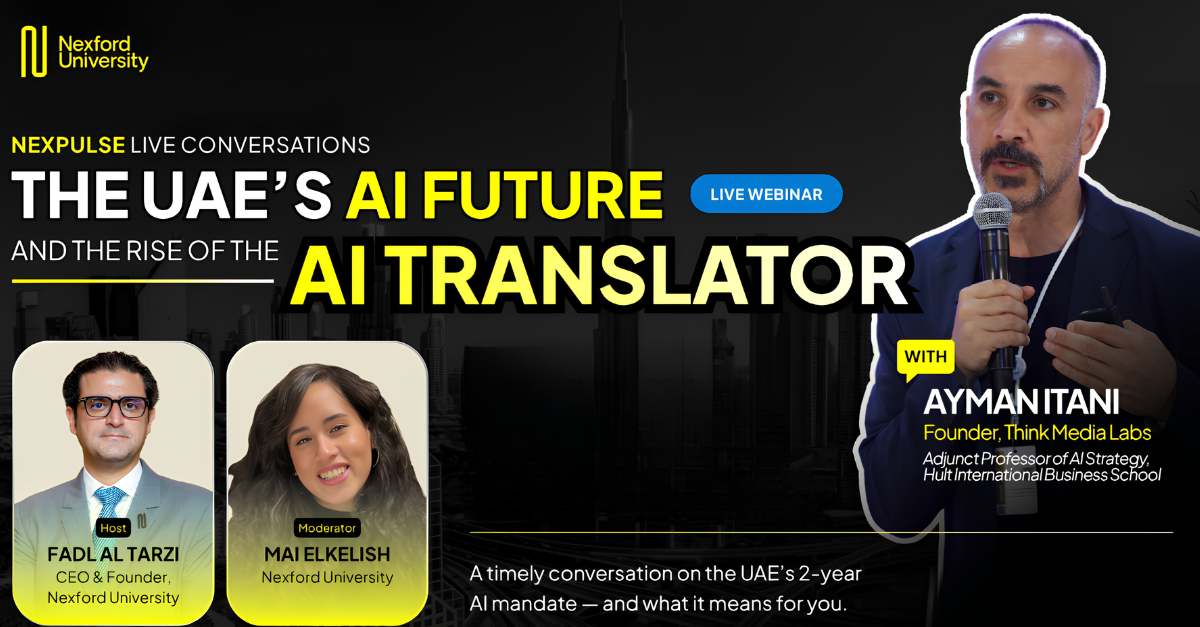
Nexford's MSAI requires zero coding. The target graduate is the "AI Translator" — a professional who understands enough about AI systems to make high-stakes decisions, communicate across technical and non-technical teams, and drive measurable business outcomes. This role is in demand in every major market globally, not just in the United States.
Graduates of Nexford's MSAI are positioned for roles including AI Project Manager, Digital Transformation Lead, Process Automation Manager, Product Manager, and Digital Operations Manager.
Who is each program actually built for?
Choose Nexford's MSAI if:
- You're a working professional in management, operations, consulting, or business strategy — based anywhere in the world
- You want to lead AI-driven transformation without becoming a developer
- You want a U.S.-accredited degree you can earn from anywhere across 160+ countries — no relocation, no case-by-case recognition checks
- You're targeting leadership roles like AI Project Manager, Digital Transformation Lead, or Product Manager
- You want to finish as fast as possible and control total program cost through your pace
- Coding is not your strength — and you'd prefer it not be required
Choose Udacity's MS in AI if:
- You're a current or aspiring AI engineer, data scientist, or machine learning practitioner
- You're comfortable with Python and want to go deeper into ML, deep learning, and agentic AI
- You want a portfolio of real-world AI projects upon graduation
- You're based in a country where Woolf's European accreditation is directly recognized, or you've verified recognition with your specific employer
- You prefer a lower monthly rate with a longer timeline
- You've already completed Udacity Nanodegrees and want to convert that work toward a formal degree
What do Nexford alumni actually report after graduating?
According to Nexford's 2026 Alumni Outcomes Report — compiled across its global alumni community spanning 160+ countries:
- 92% of alumni were employed or actively advancing their careers
- 50% received a promotion within 18 months of completing their program
- 1 in 3 saw a 50%+ salary increase since graduating
These outcomes span Nexford's full alumni base, not exclusively MSAI graduates — given the MSAI launched in January 2026, a program-specific outcomes report isn't yet available. But the broader alumni trajectory is clear: the majority of Nexford learners across the globe aren't just finishing a degree. They're moving up.
Udacity does not currently publish a comparable third-party alumni outcomes report for its MS in AI program.
Make Your Decision Based on What You're Actually Building Toward
If you want to write the code that runs AI systems, build models from scratch, and work as an engineer or developer in the AI space — Udacity's MS in AI was designed for that path.
If you want to lead the teams that deploy those systems, make decisions about AI strategy at the organizational level, and drive real business outcomes without needing to write a single line of Python — Nexford's MSAI is built for that. And you can earn it from anywhere. Lagos. Manila. London. São Paulo. Wherever you are, you graduate with the same U.S.-accredited credential.
The AI economy needs both builders and leaders. But only one program is the right fit for where you're trying to go.
Explore Nexford's MS in AI and Technology Management at nexford.edu/ms-ai-and-technology-management and see if it matches where you're headed.
Frequently Asked Questions
Will employers around the world recognize a degree from Woolf University / Udacity?
For most private-sector roles, recognition comes down to the skills and experience you bring rather than the accrediting body. Woolf's accreditation is European (MFHEA, Malta), and it carries strong recognition within the European Higher Education Area and across approximately 57 countries under the Lisbon Recognition Convention. Outside those regions — including parts of Asia, the Middle East, and Sub-Saharan Africa — Udacity's own FAQ notes that formal credential validation depends on local rules and requires case-by-case evaluation through Woolf. If your target employer, industry, or visa situation requires formal credential verification, confirm local recognition before enrolling.
How is DEAC accreditation (Nexford) different from MFHEA accreditation (Udacity/Woolf) — and why does it matter globally?
DEAC is a U.S.-based accrediting body recognized by the U.S. Department of Education and CHEA. It provides direct, recognized standing in the United States without case-by-case evaluation — and for international learners, it means earning a credential from an American university that is recognized by U.S. employers, graduate programs, and global companies that value American accreditation. MFHEA is Malta's national higher education regulator; Woolf degrees are strong within the European Higher Education Area but require case-by-case validation elsewhere.
Do I need a bachelor's degree to apply to either program?
For Nexford's MSAI, a completed bachelor's degree from an accredited institution is required. A three-year international bachelor's degree from a recognized institution qualifies — making the program accessible to learners across a wide range of global education systems. For Udacity's MS in AI, a bachelor's degree is recommended but not strictly required. Udacity offers a Performance-Based Admission (PBA) pathway for learners without a formal undergraduate degree.
Can I complete either program without knowing how to code?
Nexford's MSAI requires no coding knowledge and no programming coursework. The program is built specifically for non-technical professionals moving into leadership roles — and it was designed for learners from every background, in every market. Udacity's MS in AI, by contrast, requires foundational programming knowledge. Python is recommended from the start, and the curriculum builds heavily on it through machine learning, deep learning, and AI development courses.
How can I finish Nexford's MSAI in 9 months — and does that actually save money?
After completing your first five courses, you can apply to enroll in two courses concurrently if your cumulative GPA is 3.6 or higher and you have no outstanding tuition balance. Learners approved for this accelerated track can complete the program in approximately 9 months. At $470/month, that brings total program cost to approximately $4,230. Finishing faster at Nexford directly reduces what you pay overall.
What roles can I pursue after completing Nexford's MSAI?
Nexford's MSAI prepares learners for roles including AI Project Manager, Digital Transformation Lead, Product Manager, Business Process Manager, Process Automation Manager, Technology and Automation Lead, and Digital Operations Manager. These roles are in high demand globally — not just in the United States — making the program a practical fit for professionals building careers across multiple markets.
What roles can I pursue after completing Udacity's MS in AI?
Udacity's program prepares learners for engineering and technical roles in AI — including machine learning engineer, AI developer, data scientist, and AI researcher. The capstone involves building real AI systems across ML, generative AI, and agentic AI, which supports a portfolio-backed job search in technical roles.
What is the single biggest practical difference between these two programs?
Curriculum focus — and by extension, who each program was built for. Udacity's MS in AI is a builder's credential: Python-heavy, model-focused, designed for people who want to develop AI systems. Nexford's MSAI is a leadership credential: strategy-focused, non-technical by design, built for professionals who want to direct and manage AI initiatives. It's available to working professionals in 160+ countries, and every graduate earns the same U.S.-accredited degree regardless of where they're based. Choose based on which role — and which credential type — fits where you're headed.
Sources and Related Reading
- Nexford MS in AI and Technology Management
- Udacity Master of Science in Artificial Intelligence
- Woolf University Accreditation Status
- DEAC – Distance Education Accrediting Commission
- PwC 2025 Global AI Jobs Barometer
- Nexford 2025 Alumni Outcomes Report
Subscribe to our newsletter
Don't miss out on our latest updates.


Unlock Your Potential: Explore Our Programs
Invest in yourself and your future. Discover our range of degrees, courses, and certificates to achieve your goal
 BACK TO BLOG PAGE